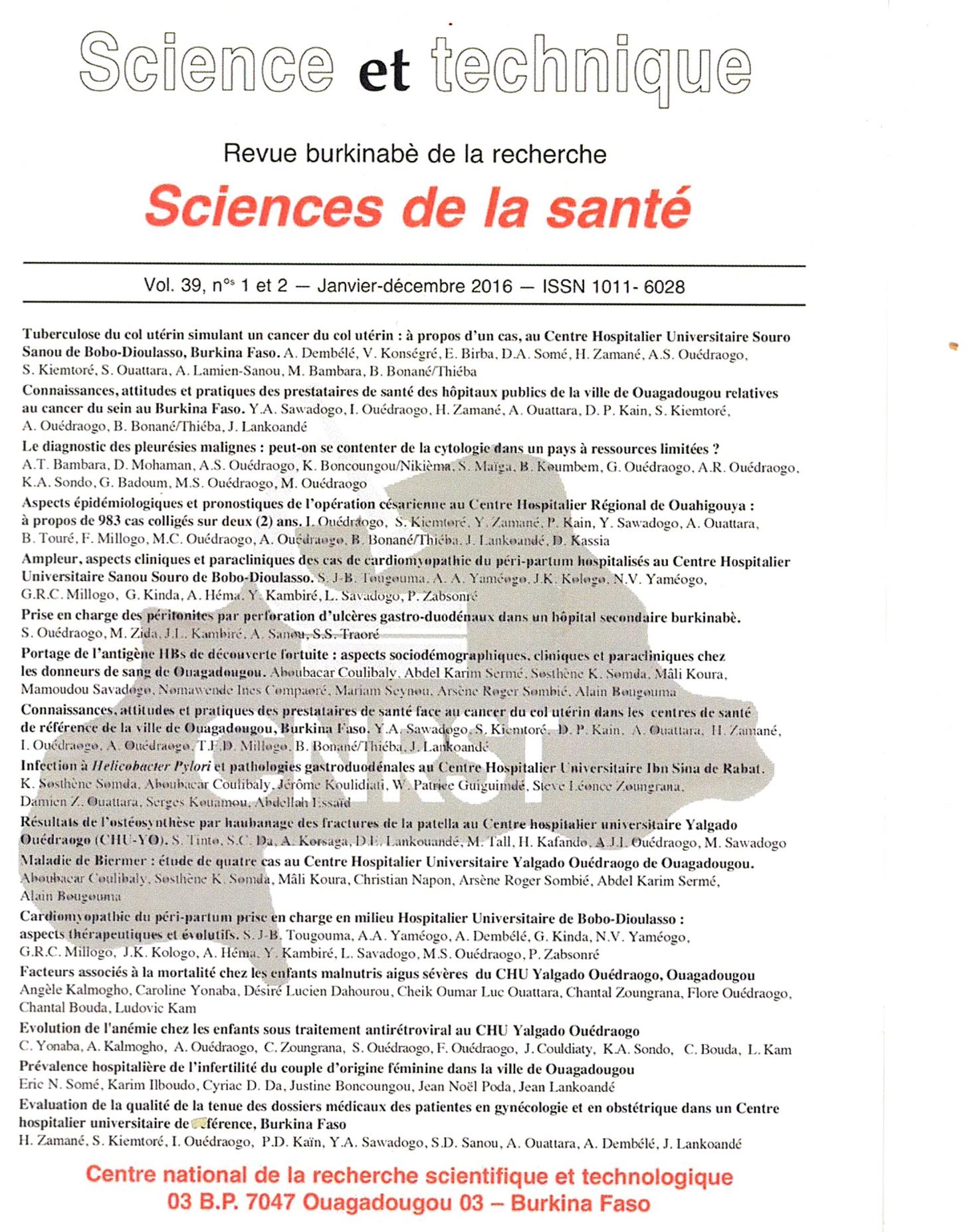
Knowledge, attitude and practice of Ouagadougou hospitals' health care providers towards breast cancer
Keywords:
Connaissances, attitudes, Pratique, Cancer, Sein, Prestataires de santéAbstract
This study was carried out to assess the knowledge, attitudes and practices of healthcare providers in the gynaecology and obstetrics departments of hospitals in the city of Ouagadougou with regard to breast cancer. This was a descriptive cross-sectional study carried out using an administered and anonymous questionnaire. It took place from 02 December 2013 to 30 May 2014. We surveyed 150 healthcare providers. Breast cancer is not well known among providers. In fact, only 22% and 36.7% of the providers questioned had a good knowledge of risk factors and screening methods respectively. The suggestive signs and additional tests needed to diagnose breast cancer were known by 15.3% of providers. The definition of breast cancer and the means of treatment available in Burkina Faso were the items best known by the providers (64.7% and 61.3%). In terms of attitude, 98% of the providers said that breast cancer was a serious disease and 81% said it was curable. All providers were in favour of systematic screening. As for providers' practice, 88% and 10.66% said they practised clinical breast examination and breast cancer management respectively. Finally, there are shortcomings in the knowledge, attitudes and practices of healthcare providers in gynaecology and obstetrics. Self-training for the providers themselves and ongoing training on breast cancer could fill these gaps.
English
The aim of this study was to evaluate knowledge, attitudes and practices of Ouagadougou public hospitals' healthcare providers about breast cancer. A descriptive cross-sectional study was conducted under with an administered and anonymous questionnaire. It took place from December 2, 2013 to May 30, 2014. We surveyed 150 health care providers. 13reast cancer is not well known by the providers. In fact only 22 % and 36.7 % of surveyed providers had respectively a good knowledge of risk factors and screening means. The evocative signs and additional tests for the diagnosis were known respectively by 15.3 % of providers. The breast cancer definition and treatment means available in Burkina Faso were the best known items by providers (64.7 % and 61 .3 %). Regarding the attitude, healthcare providers said that breast cancer, in 98% thought that it was serious, and 81 % it was curable. Ail the providers were in favour of routine screening for breast cancer. As for the practice of health care providers, 88% and 10.66% respectively said practicing clinical breast examination and management of breast cancer. In conclusion, deficiencies related knowledge, attitudes and practices of healthcare providers exist. Self-training of providers and continuous training on screening, diagnosis and treatment of breast cancer could address these deficiencies.