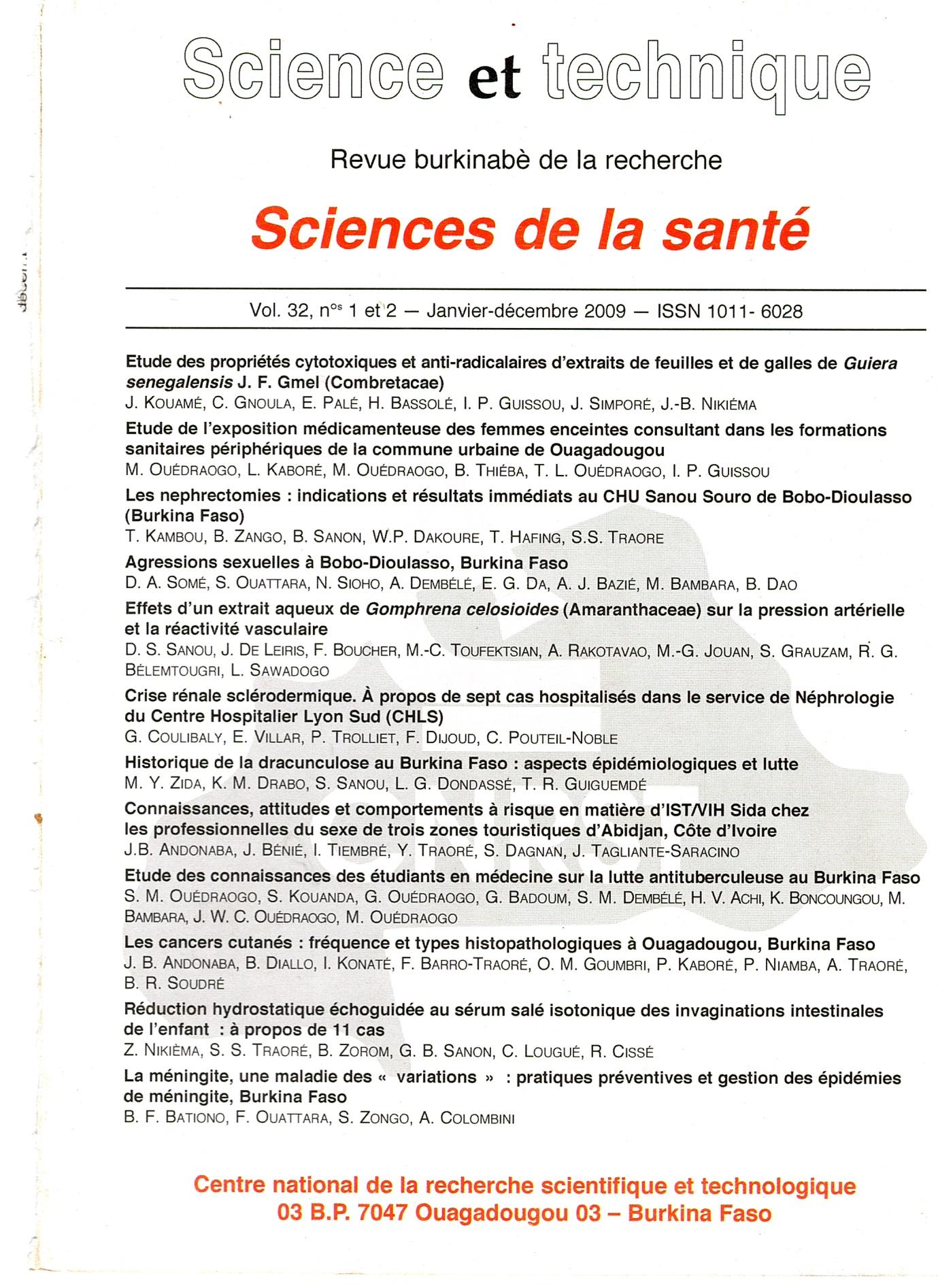
Crise rénale sclérodermique. À propos de sept cas hospitalisés dans le service de Néphrologie du Centre Hospitalier Lyon Sud (CHLS)
Scleroderma renal crisis. About seven cases hospitalized in the Nephrology Service of Centre Hospitalier Lyon Sud (CHLS
Keywords:
Crise rénale, Hypertension artérielle, Microangiopathie thrombotique, SclérodermieAbstract
Français
La crise rénale sclérodermique (CRS) est la forme la plus sévère des atteintes rénales au cours de la sclérodermie systémique (ScS). Nous avons étudié la présentation clinique et le pronostic des cas de CRS hospitalisés dans le service de Néphrologie du Centre Hospitalier Lyon Sud de 1994 à 2004. Ont été inclus les patients atteints de ScS qui ont présenté au moins : une insuffisance rénale aiguë ou subaiguë associée ou non à une hypertension artérielle (HTA). Une microangiopathie thrombotique (MAT) ou une histologie rénale évocatrice. Sept cas de CRS ont été hospitalisés dans le service durant la période d'étude. Il existait au diagnostic de la CRS une insuffisance rénale (sept patients), une HTA (sept patients) ou une HTA (quatre patients). Les lésions histologiques rénales étaient caractéristiques dans sept cas. Tous les patients ont reçu un traitement avec les inhibiteurs de l'enzyme de conversion de l’angiotensine. La pression ar1érielle a été contrôlée chez six patients. Six patients ont été mis en hémodialyse. Cinq sont décédés.
Notre étude est l imitée par la petite taille de l'échantillon. Elle confirme malgré tout la rareté de la CRS, sa gravité et ses pronostics rénal et vital péjoratifs.
Anglais
Scleroderma renal crisis (SRC) is the most severe form of renal diseases in systemic sclerosis (SSc). We studied the clinical presentation and prognosis of hospitali1ed cases of SRC in the department of Nephrology the Centre Hospitalier Lyon Sud from 1994 to 2004. Were included patients with SSc who had at least: an acute or subacute renal failure with or without hypertension, a thrombotic microangiopathy (TMA), or suggestive renal histology. Seven cases of SRC were hospitalized in the depai1ment during the study period. At the diagnosis of SRC, there was renal failure (seven patients), hypertension (seven patients) or TMA (four patients). The renal histological lesions were typical in seven cases. Ali patients were treated with angiotensin converting enzyme inhibitors. Blood pressure was controlled in six patients. Six patients were on hemodialysis. Five died. Our study is limited by the small sample size It still confirms the rarity of the SRC, its severity and pejorative renal and vital prognosis.